

TIES now has over 30 years of experience in providing foster- and adoption-specific services to children requiring permanency and resource families. The program has won many awards, and staff have authored numerous publications and presented locally and nationally on the program and information learned. We have knowledge of, experience with, and are passionate about prevention, early intervention, and health equity, particularly for youth in or adopted from foster care.
Recent Highlights
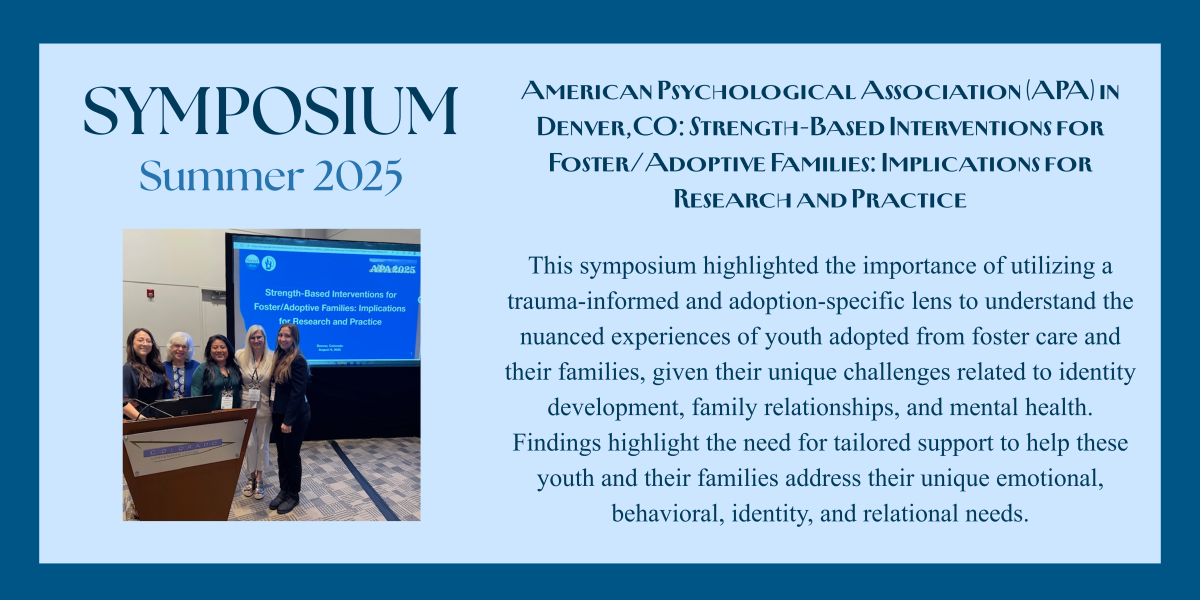
Left to right: Jennifer Scheller, Ph.D.; Jill Waterman, Ph.D.; Erika Luis Sanchez, Ph.D.; Audra Langley, Ph.D.; and Regina Brodell, Ph.D. Student
Contributor: Matthew Ruderman, Ph.D.
Research Spotlight
By Matthew Ruderman, Kenyon Lee Whitman, Vanessa Perez, Jill Waterman, Todd Franke, Audra K. Langley Published in Journal of Public Child Welfare
ABSTRACT
Resource parents (n = 527) in Los Angeles County were surveyed about their experiences with COVID-19, comparing the beginning of “Safer-at-Home” to over a year later. The findings reveal increased infection rates, maintained or increased reports of adverse impact and coping challenges, decreased reports of positive impact, and increased access to resources across time points. Compared to White resource parents, Black and Latinx resource parents reported both more adverse and more positive impact and less access to resources. Further, single caregiver households reported more financial worries, and foster parents and kinship caregivers reported more coping challenges than foster-adoptive parents.
KEYWORDS
adoption, child welfare, COVID-19, resource parents, health disparities
Access full article HERE.
By Kenyon Lee Whitman, Matthew Ruderman, Vanessa Perez, Jill Waterman, Todd Franke, Audrey K. Langley
Published in Journal of Public Child Welfare.
ABSTRACT
The emergence of COVID-19 created a global health crisis and impacted children and families, disproportionately affecting minoritized communities. Simultaneously, protests and anti-racist uprisings against police violence occurred worldwide. This mixed method study examined how a group of racially diverse resource parents navigated these two pandemics. Resource parents (N = 527) in Los Angeles County were surveyed about concerns related to COVID-19, racial injustice, and the sociopolitical climate. Quantitative findings revealed that increased difficulty coping with COVID-19 was associated with the increased reported impact of events surrounding racial injustice. Qualitatively, resource parents expressed a concern for children and stress, anxiety, and fear.
KEYWORDS
COVID-19, racial injustice, resource parents, child welfare, transracial families
Access full article HERE.
By Vanessa Perez, Matthew Ruderman, Meghan Kussman, Jill Waterman, Audra Langley
Published in Social Work in Mental Health, 21(2), 203-221.
ABSTRACT
Using the electronic health records of 55 foster and adopted youth, this study compared in-person mental health service utilization to telemental health (TMH) service utilization during COVID-19. Clients attended a greater number of therapy sessions, had more accumulated session time, and had shorter sessions via TMH compared to in-person. Similar results were found for school-aged children, females, and caregivers who engaged in their children’s treatment. Notably, for non-significant differences in engagement, engagement numbers during TMH were always higher than in-person services.
KEYWORDS
Telemental health, engagement, service utilization, foster care, COVID-19
Access full article HERE.
By Erum Nadeem, Austin J. Blake, Jill M. Waterman Published in Adoption Quarterly, 1-21.
ABSTRACT
Concurrent planning is a process by which all options for permanency are considered simultaneously for children in foster care. Children are placed with caregivers (resource parents) who are open to adoption if reunification with birth parents does not occur. This quantitative study explored resource parents’ perceptions of the concurrent planning process via surveys at two time points. Participants included resource parents of 77 infants assessed at 2 months and 1 year after placement. At Time 1, resource parents who had more birth parent visits, more concerns about legal issues, and more concerns about their interactions with the child welfare system had more negative perceptions of the placement. Although concerns decreased over time, specific concurrent planning concerns (i.e., legal issues, child welfare agency issues, birth parent visits) at Time 2 were associated with greater concerns among resource parents about the placement in general as well as about child development and behavior, perceived attachment, and their own parenting. Additionally, those with infants placed older held more concerns about their attachment to the child, the child’s attachment to them, and the child’s behavior. While concurrent planning is positive for infants in foster care, the process creates stressors for resource parents.
KEYWORDS
parental concerns, attachment issues, foster care system, child welfare
Access full article HERE.
By Audra K. Langley, Matthew Ruderman, Jill Waterman, Todd Franke Published in Developmental Child Welfare, 3(3), 185-202.
ABSTRACT
The emergence of COVID-19 forced significant adaptations for families worldwide. Children and youth in foster care and their caregivers or resource parents experience unique stressors. The current study aimed to understand the impact of the COVID-19 pandemic and “Safer-at-Home” orders on resource parents in Los Angeles County. Resource parents (n = 648) were surveyed about COVID-19 concerns, positive impact and strengths, access to and helpfulness of provided resources, visits with birth parents, children joining their families during the pandemic, and transition to telehealth. Between one-third and half of resource parents with foster or foster-adoptive children in their home reported significant anxiety about issues such as getting infected, uncertainty about the future, and financial hardship. In contrast, most resource parents reported some perceived benefits, such as increased family closeness. The most helpful resource reported was video visitation by social workers. A quarter of resource parents experienced in-person birth parent visits. Developmentally, parents with a foster or foster adoptive child 0–5 years old reported significantly more worries related to COVID-19, while those with children of multiple ages reported feeling less valued as a resource parent and expressed more concerns about children falling behind with school, mental health and developmental services, birth parent visits, and delayed reunification. Lastly, younger parental age, fewer foster children in the home, and the less negative impact from COVID-19 a resource parent reported having were associated with an increased likelihood of resource parents welcoming a child into their home. Implications for policy and recommendations for practice are discussed.
Access full article HERE.
By Austin J. Blake, Matthew Ruderman, Jill M. Waterman, Audra K. Langley
ABSTRACT
Children adopted from foster care are at heightened risk for emotional and behavioral challenges, potentially due to early trauma exposure and related risk factors. Research has demonstrated that adoptees with greater pre-adoptive risk exhibit higher rates of internalizing and externalizing problems across childhood and into adulthood. However, these studies have been limited by their use of individual risk factors or sum scores of cumulative risk and their measurement of internalizing and externalizing behaviors separately. The current study aimed to examine effects of pre-adoptive risk on long-term functioning in children adopted from foster care. In a longitudinally-followed sample of 82 adoptees, we utilized latent growth curve modeling to examine effects of two latent indices of pre-adoptive risk, postnatal (i.e., trauma-related) risk and prenatal risk (not including prenatal substance exposure, since it was nearly ubiquitous in this sample), on adoptee internalizing, externalizing, and latent scores of dysregulation across childhood. Additionally, in three separate models, we tested whether baseline levels and change across childhood in internalizing, externalizing, and dysregulation mediated effects of prenatal and postnatal risk on adolescent/young-adult functioning. Greater postnatal risk, but not prenatal risk, predicted higher levels of internalizing and dysregulation across childhood. However, only dysregulation mediated the effect of postnatal risk on adolescent/young-adult functioning. These results are consistent with prior research evidencing long-term effects of postnatal pre-adoptive risk, but not prenatal risk, in adoptees. Furthermore, they suggest that trauma exposure in this population may result in a profile of broad dysregulation that increases risk for maladjustment into adulthood.
Access full article HERE.
By Erum Nadeem, Jill Waterman, Jared Foster, Emilie Paczkowski, Thomas R. Belin, Jeanne Miranda
Published in Journal of Emotional and Behavioral Disorders, 25(2), 67-81.
ABSTRACT
This exploratory longitudinal study examined behavioral outcomes and parenting stress among families with children adopted from foster care, taking into account environmental and biological risk factors. Child internalizing and externalizing problems and parenting stress were assessed in 82 adopted children and their families at 2 months post-placement, 12 months post-placement, and then yearly until 5 years post-placement. A history of abuse/neglect predicted significantly higher externalizing and internalizing problems at a borderline level of statistical significance. In the initial stages after placement, externalizing problems were significantly higher among children who were 4 years or older at placement versus those who were younger than 4, although differences were no longer significant 5 years post-placement. Statistical trends in parenting stress reflected reduced stress in the first 12 months followed by a plateau for parents who adopted older children and greater stress for parents who adopted younger children. Familiar limitations for observational cohort data apply. Nonetheless, the availability of longitudinal follow-up on a sizable sample of children adopted from foster care adds insight to the psychological dynamics for adoptive families and suggests that families of children adopted from the foster care system may have unique needs for ongoing support around behavioral issues.
Access full article HERE.
By Susan B. Edelstein, Araceli Gonzalez, Audra K. Langley, Jill Waterman, Maris Paasivirta, Emilie Paczkowski Published in Adoption Quarterly, 20(1), 119-133.
ABSTRACT
This investigation evaluated the effectiveness of a pre-placement education and preparation curriculum (PREP) for prospective foster/adoptive parents in improving attitudes toward children with prenatal substance exposure and their substance-using birth parent and increasing willingness to adopt these children. Participants included 1,836 prospective parents seeking adoption through foster care who received three 3-hour sessions of PREP. Prospective parents completed questionnaires assessing their knowledge about important issues involved in adopting a child from foster care, attitudes, and willingness to adopt children with a variety of characteristics. Changes from pre- to post-intervention were examined. Results indicated significant increases in self-reported knowledge; significantly more positive attitudes toward substance-abusing parents and children with prenatal substance exposure; and significantly increased willingness to adopt children with a variety of potential difficulties, including children with serious behavior problems, attention deficit hyperactivity disorder, and a biological history of mental illness. In sum, findings suggest that prospective adoptive parents who attended the PREP sessions felt better prepared by the end of training with regard to issues related to adoption of high-risk foster children with special needs, particularly those with prenatal substance exposure.
KEYWORDS
adoption parenting training, foster care preparation
Access full article HERE.
By Jill Waterman, Erum Nadeem, Emilie Paczkowski, Jared Cory Foster, Justin A. Lavner, Thomas Belin, Jeanne Miranda Published in Child Welfare, 92(4), 9-30.
ABSTRACT
This study examined the trajectory of cognitive development over the first five years of adoptive placement among children adopted from foster care and how pre-adoption risk factors relate to this development. Overall, children’s cognitive scores increased significantly, with the most rapid improvement occurring in the first year post-placement. By five years post-placement, children’s mean cognitive and achievement scores were in the average range. Adoption is a positive intervention for children’s cognitive development.
Access full article HERE.
Click here for an overview of TIES Research Papers, Presentations, and Posters